Bi-vocational and volunteer youth workers carry a unique burden. You care deeply about students, but youth ministry is not the only responsibility competing for your time. You have a job, a family, church responsibilities, and a life outside the youth group. You do not have extra hours to build the kind of ministry a large church can create with a full-time staff and a large budget.
That can leave you feeling as though your ministry is always behind. You see what larger churches offer and wonder how you could ever give your students the same opportunities.
I want to free you from that comparison. The goal is not to imitate a large church. The goal is to leverage the unique strengths of a small church to make a lasting impact on students.
Small does not mean ineffective. In fact, when you understand what a small youth ministry can do best, small can lead to more effective ministry.
A Model Built for Bi-vocational and Volunteer Youth Workers
At LeaderTreks, we care deeply about bi-vocational and volunteer youth workers. We know you are not looking for one more complicated ministry strategy that requires more staff, more money, and more time. You need a plan that respects the realities of your life while helping you build a youth ministry that is relational, intentional, and sustainable.
That is why we created the Bi-vocational and Volunteer Youth Ministry Model. This model is not a scaled-down version of a large-church program. It is a ministry plan built around the strengths of a smaller church and the priorities that matter most. It gives youth workers a simple framework for deciding where to invest their limited time and energy.
The model has five connected parts:
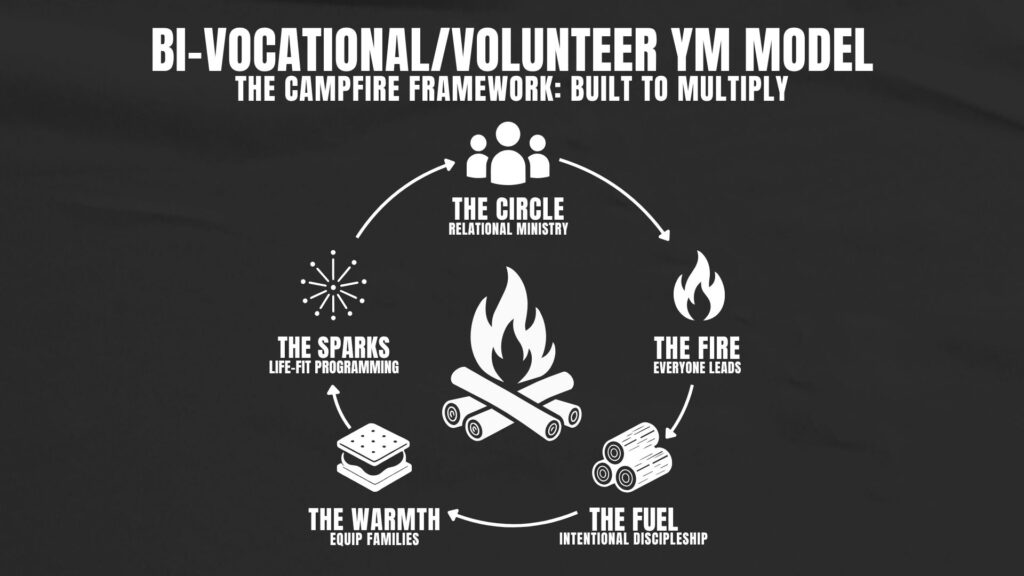
The Circle represents meaningful relationships. In a smaller ministry, students can gather close and be truly known. The goal is to move beyond knowing faces and facts to understanding students’ feelings, fears, and faith.
The Sparks represent life-fit programming. Life-fit programming makes those relationships and priorities sustainable. Bi-vocational workers and busy families do not have many open nights or weekends for additional events. Instead of constantly adding programs, the model helps youth workers integrate ministry into the existing rhythms of church and family life. Ministry can happen around the family table, during a service project, on the drive to an activity, or through an intentional conversation after church. The program fits people’s lives instead of asking their lives to revolve around the program.
The Fuel is an intentional discipleship pathway. Programs are tools, but programs alone cannot sustain spiritual growth. Students need a clear process that helps them understand biblical truth, practice spiritual habits, develop Christlike character, and live out their faith.
The Warmth represents the influence that reaches beyond the youth group. Youth workers equip students to minister and partner with parents to disciple their teenagers through conversations, spiritual guidance, shared experiences, and leadership opportunities.
The Fire is leadership development. Healthy ministry is tended by more than one person. Instead of carrying everything yourself, you develop parents, volunteers, and students by giving them meaningful responsibility in the ministry you are already doing.
Together, these priorities give bi-vocational and volunteer youth workers a focused plan: know students deeply, build ministry around real life, disciple students intentionally, equip their families, and develop others to lead. This is how LeaderTreks wants to serve you—not by asking you to do more, but by helping you focus on what produces lasting spiritual growth.
Stop Trying to Recreate the Large-Church Program
You are not called to run programs. You are called to minister to students and their families.
Programs can be useful tools, but they are not the ministry. Resist the urge to give your students everything you think students at other churches have. You do not need a packed calendar, a high-energy event every week, or separate programming for every age and grade.
A small youth group gives you freedom. You can adapt quickly, respond personally, and organize students around maturity rather than simply age or grade. You can change plans when a student needs help. You can include families instead of competing with their schedules. You can build ministry around the people God has actually placed in front of you.
That kind of flexibility is not a weakness. It is one of your greatest strengths.
Build the Ministry Around Relationships
Small youth ministries have the opportunity to know students deeply. But being in a small room together does not automatically create meaningful relationships. You still have to be intentional.
A first-level relationship means you know a student’s face and some facts about his or her life. You know where the student goes to school, what sport they play, and something about their family.
A second-level relationship goes deeper. You begin to understand the student’s feelings, fears, and faith. You know what is bringing joy, what is creating anxiety, where the student has doubts, and how God is working in their life.
That is where discipleship begins. Students do not need another adult who simply recognizes them at church. They need adults who listen, ask intentional questions, and help them connect everyday life with biblical truth. A smaller ministry gives you space to do that well.
Create Life-Fit Programming
Bi-vocational youth workers do not have time to produce endless events, and families do not have many open nights or weekends to attend them. So stop measuring ministry by the number of activities on the calendar.
The best youth ministry programming often fits into the life of the church and the rhythms of the family. Youth ministry can happen around a family’s table, during a service project, on a drive to a game, or through a conversation after church. The events students cannot miss are usually important because of the relationships involved, not because the activity is spectacular.
Ask a simple question: How can youth ministry fit into what our church and families are already doing? That question can save time while creating more natural opportunities for discipleship.
Keep the Fire Fueled With Intentional Discipleship
Programs may help start a fire, but intentional discipleship keeps it burning. Without a clear pathway for spiritual growth, even a busy youth ministry eventually loses its energy.
Teenagers need more than information. They need to learn how to follow Jesus. Help them understand Scripture, build spiritual habits, develop Christlike character, and explain and live out their faith.
You do not need a complicated system. Decide what you want students to understand, practice, and become. Then repeat those priorities through Bible study, conversation, prayer, service, and evaluation. Consistency matters more than complexity.
Equip Families to Disciple Their Students
The influence of your ministry should reach beyond the youth room. One of the most important things a bi-vocational youth worker can do is equip parents to disciple their own students.
Help families grow through four simple areas:
Conversations: Teach parents to listen well, ask intentional questions, discuss difficult issues, and connect everyday experiences to biblical truth.
Spiritual guidance: Help parents guide their teenagers in biblical understanding, spiritual habits, Christlike character, and the ability to live out their faith.
Shared experiences: Encourage families to serve, practice generosity, make decisions together, take on appropriate challenges, and put faith into action.
Leadership opportunities: Help parents trust students with meaningful responsibility, allow them to take appropriate risks, learn from failure, evaluate their growth, and use their gifts to serve others.
You cannot personally disciple every student during every moment of the week. But you can multiply your influence by helping parents become more intentional.
Develop Leaders Through the Ministry You Already Have
Leadership development is not one more program to add. It is a different way of doing the ministry you already have.
A healthy fire is tended by more than one person. If the ministry depends entirely on you, it will eventually exhaust you and limit everyone else. The answer is not to begin by building a large leadership team. Begin with one person.
Pick one parent, volunteer, or student who is faithful, teachable, and cares about the ministry. Then choose one real responsibility you currently carry and ask that person to own it. A parent could manage trip communication. A volunteer could lead the small-group team. A student could plan the welcome time or organize a service project.
Explain three things clearly: What needs to be done? Why does it matter? What does success look like? That conversation may take only ten minutes, but clarity saves time later.
Then let the person do it. Give enough freedom to make decisions and complete the responsibility differently than you would. If you control every detail, you have delegated a task, but you have not developed a leader.
Finally, take five minutes to debrief. Ask: What did we do well? What could we do better? What will we do differently next time? This simple process turns normal ministry responsibilities into leadership-development opportunities.
Use the Strengths God Has Given You
Bi-vocational and volunteer youth ministry is demanding, but it is not second-class ministry. You may not have extra time, a large budget, or a staff team. What you do have is the opportunity to know students deeply, partner closely with families, adapt quickly, and give people meaningful responsibility.
Do not apologize for being small. Do not wear yourself out trying to look large. Minister personally. Disciple intentionally. Equip families. Develop one leader at a time.
You do not need a big youth ministry to make a big impact. You need to faithfully use the people, relationships, and opportunities God has already given you.