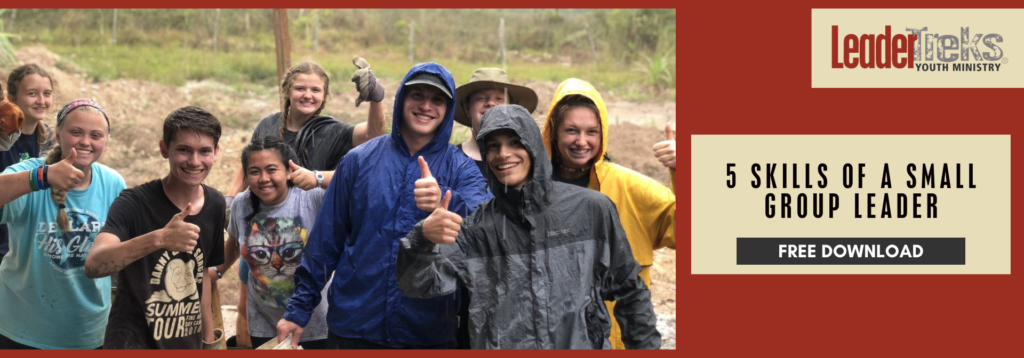
5 Skills of a Small Group Leader
Most youth workers spend their time on programming and relationship building. Both are very good things. But are they the most effective use of your time? Is there a better way to grow students spiritually and grow your youth ministry?
I personally believe there is. Investing time in your small group leaders can give you the best bang for your buck. You can have a transformational relationship with about 3–5 students at a time, if you’re Superman. If you invest your time into 10 adult volunteer leaders, they can have transformational relationships with about 30–50 students at a time.
So here is the real problem: most youth workers don’t know how to train their adult volunteers on how to disciple a student. I know that is a bold statement, but it’s true. Ask any youth worker what their strategy is for developing adult volunteers, and they don’t have an answer.
So let me help get you started. Here are 5 skills every small group leader should be working on:
BUILD MEANINGFUL RELATIONSHIPS
Discipleship cannot take place outside the context of a deep and meaningful relationship. Students want to learn from people who care about them; they want to be discovered and known. The key to discovering a student is asking questions. Begin by asking about their friends at school or their favorite sports team and then dive into questions that get at students’ hopes, fears, struggles, and dreams. A meaningful relationship is what lays the foundation for continued discipleship.
SHARE PERSONAL STORIES
Our personal stories are one of our greatest tools in the discipleship process. When shared with a student, our bad decisions and past mistakes point to God’s mercy and forgiveness and demonstrate God’s ability to work in and through broken individuals. Our vulnerability encourages students to be vulnerable and opens the door for students to more fully understand and experience God’s grace.
ASK INTENTIONAL QUESTIONS
Intentional questions get students to think beyond the “right answer” and dive deeper. Transformational discipleship requires that we ask questions like, “Why is that important to you?” or “What would that look like if lived out in your life?” In doing so, we challenge students to seek out the truth and begin to own their beliefs.
MAKE LIFE APPLICATIONS
As disciple-makers, we must ask students to make practical and tangible life applications. Great applications answer the questions “Who? What? Where? When? How?” The application of “I want to love my younger brother more” becomes “I will make a snack for my younger brother when he gets home from school on Wednesday.” Specific and measurable applications give students ways to put their faith into action.
HOLD STUDENTS ACCOUNTABLE
Accountability provides sharpening to the life and walk of a disciple. By taking the time to debrief students’ applications and ask them about it later on, we can see for ourselves if a lesson made an impact. If the student follows through, we know that transformation is taking place. If they don’t, we have another opportunity to find out why.
Train your adult volunteers to develop these skills, and your youth ministry will deepen and grow.

About the Author
Doug Franklin
Doug Franklin is the president of LeaderTreks, an innovative leadership development organization focusing on students and youth workers. Doug and his wife, Angie, live in West Chicago, Illinois. They don’t have any kids, but they have 2 dogs that think they are children. Diesel and Penelope are Weimaraners who never leave their side. Doug grew up in… Read More